
Guardrails in social housing & public housing renovation
Using the Dampere railing configurator, renovating a custom balcony with personalized finishes is as easy as selecting a menu to be delivered on an app. If you're used to ordering takeout from a website, configuring your metal railing is just as quick. In just a few clicks, you can configure your metal balustrade and view the result in 3D based on the specific measurements of your balcony! The dimensions adapted to your concrete slab renovation project are integrated with precision. From your cell phone, you can order decorative perforated balcony sheet metal or modern black mashrabiya balustrade infill .
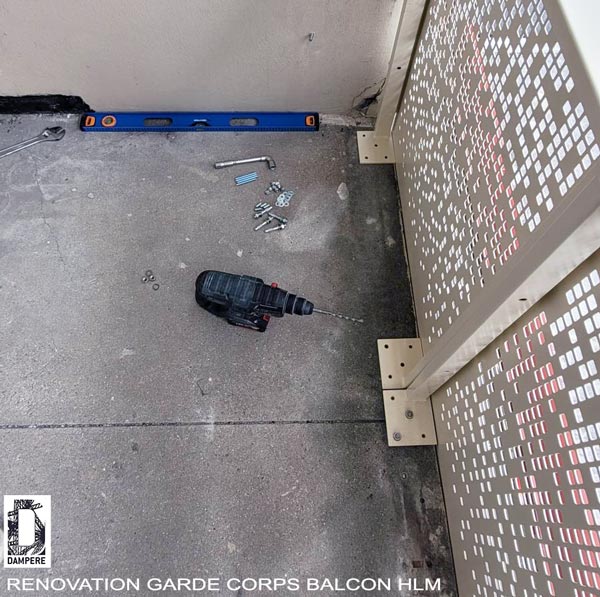
But that's not all the Dampere guardrail kit has to offer! It can be quickly and easily installed on renovation sites thanks to height adjustment tools that compensate for age-related defects. The concrete slab built in the 1960s has suffered from wear and tear over time. The building has inevitably moved differently on the balconies of the public housing complex. The Dampere guardrail adjustment tools Dampere adjust the height of the handrail for a clean finish. To install, simply drill four holes in the concrete slab, install the anchors in the ground, and you're done! No additional skilled labor is required; even temporary workers trained on site or novice builders can easily handle the job. Installing the guardrail is easy for everyone.
The perforated sheet metal railing kit is offered at an attractive price and is incredibly easy to install. No additional accessories are required for installation, and no specific technical skills are necessary for effective installation. You will be amazed at how easy installation is, just like the configuration on the online application.
The online railing design tool guides you through each step of customizing the product, just like ordering a pizza online. With thousands of possible combinations available by adjusting the railing settings, the 3D image displayed on your computer screen accurately reflects the project you have in mind for your public housing balcony renovation. You can customize each component of your kit according to your specific needs. Ordering is immediate via the web protocol and installation is simplified. The DAMPERE railing kit has been specially designed to combine the elegance of beautiful perforated sheet metal with ease of installation.
Prototype guardrail for public housing renovation
The importance of creating a prototype balcony railing for an old 1960s public housing complex lies in the need to verify that the railing is compatible with the existing infrastructure. These buildings, which bear witness to a bygone era, often require renovation to meet current safety and aesthetic standards. The renovation of the residential building focuses primarily on insulating the facade in order to meet environmental requirements and prevent heat loss. As part of this work, it is necessary to align the facade finishes with the metal railing modules.
Firstly, creating a prototype allows the specific needs of the building to be assessed. Social housing from the 1960s can have unique design and structural characteristics, making it essential to develop a tailor-made solution. The prototype provides an opportunity to adapt the guardrail to the dimensions and specific features of the balcony, ensuring a perfect fit with the thickness of the cladding and insulation.
In addition, the prototype allows the integration of the guardrail to be tested in real-life construction site conditions. Older buildings can present unique challenges such as uneven surfaces or aging materials, with floors adapted by residents over the years with tile or wooden decking. A well-designed prototype guardrail for public housing ensures that the metal kit can adapt to the constraints and guarantee the uniformity of the facade.
The prototype on site offers the flexibility needed to make adjustments and improvements before proceeding with the mass installation of bar railings in public housing. This allows for optimization of the railing's appearance and dimensions.
The creation of a prototype balcony railing for an old 1960s public housing complex is a crucial step in the renovation process. Thanks to Dampere production system, it guarantees a short completion time and compliance with standards.
Guardrails for renovation of 1960s public housing
The easy-to-install balcony guardrail offers a pre-assembled safety solution, specially designed to simplify the installation process and provide effective protection against falls from your balcony, particularly in the context of renovating 1960s public housing. Thanks to factory pre-assembly, the kit is delivered with its components already assembled as far as possible, reducing the time required for on-site preparation and installation. The railing components are designed to be easily attached to the balcony structure using simple fasteners, whether chemical or mechanical. Detailed instructions, accompanied by explanatory videos, are provided to guide you step by step through the installation process, which requires very few tools: a drill, a spirit level, and a screwdriver are all you need. This flexible design allows for easy adaptation to different balcony configurations without compromising safety. Its ease of installation does not compromise its mechanical strength. The Dampere railing remains sturdy and compliant with safety standards, providing reliable protection against accidental falls from the balcony.
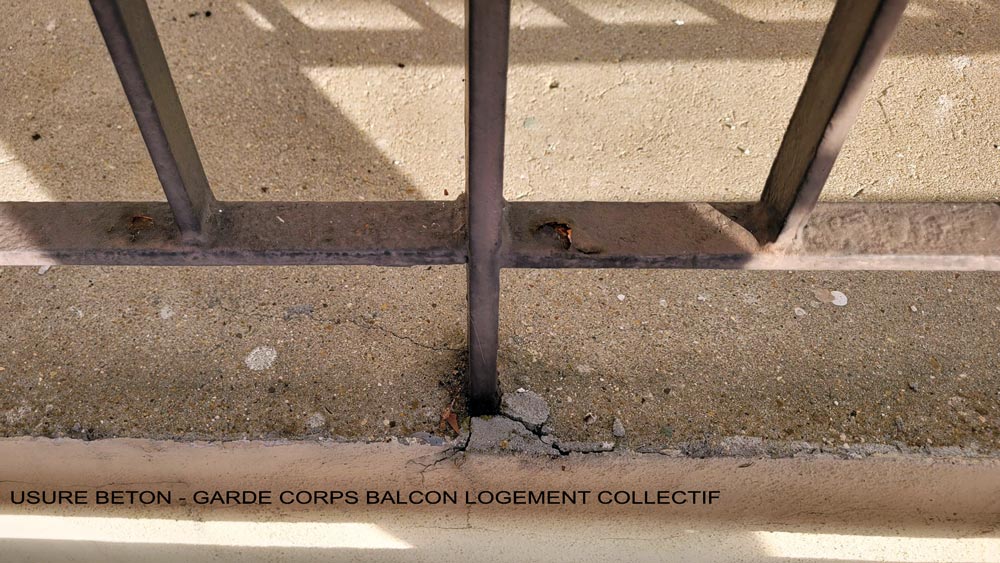
The adjustment of the guardrail on the concrete slab and the flexibility of the dimensions are crucial elements for the successful renovation of a 1960s public housing building. The dimensions of a guardrail must be adjusted correctly when renovating a 1960s public housing building due to several factors, including wear and tear over time, which gradually deforms a building that has been in use for more than 60 years, and initial defects in mass housing production linked to the urgent need to rehouse a growing population. These two factors combined can alter the structure of the building and create irregularities. Several reasons for using the adjustable Dampere guardrail for precise adjustment when renovating public housing are detailed below.
Adapting to structural imperfections is the main reason for adjusting guardrails during renovation. Over the years, concrete structures in buildings can suffer deformation due to heavy loads applied to balcony slabs and defects in the composition of the concrete mix or the layout of the reinforcing steel. Cracks appear on the building's facade, and water drainage slopes on balconies vary from one row to another.
In other cases, we find significant variations in balcony size of several centimeters, when they should be exactly the same size. A custom-made guardrail will fit well if it can adapt to these imperfections to ensure a safe and secure installation. The online configurator allows you to adapt all guardrail sizes to best fit each balcony size, even if the original construction has defects of several centimeters.
In addition, the height adjustment of the Parefit guardrail plates allows you to adjust the position of the kit for perfect alignment of the modules despite variations in slope.
Renovation of guardrails Social housing bar
What design should be chosen for the renovation of a horizontal row of social housing units?
For a long linear guardrail installation in a social housing project in Barre HLM, different decorative motifs can be used to meet various aesthetic and functional requirements for the metal base.
The primary architectural goal is to accentuate the horizontal effect of the apartment block.
To reinforce the perspective effect towards the horizon, linear or horizontal patterns can be favored, such as the Texas perforated sheet metal pattern. For example, parallel lines in the design, continuous bands, or stretched geometric patterns such as the Archipel laser-cut railing in the horizontal direction can be used to emphasize the length of the balcony and create a sense of visual continuity that extends toward the horizon, giving the optical illusion of a larger balcony and thus increasing the pleasure of using it.
In other circumstances, public housing blocks are really too long and create a sense of mass. Verticality must therefore be added to the building by using modules on the facade and filling in the base of the guardrail. To introduce a sense of verticality and contrast with the horizontal aspect of the public housing block, vertical or progressively ascending balustrade patterns can be chosen, such as Lones guardrail. This theme can include not only vertical lines, but also floral patterns such as the Roseau railing or architectural patterns that extend upwards, giving the illusion of height and elevation to the balcony included in a public housing block.
The thermal renovation of a public housing block always involves work on the railings. Most public housing buildings from the 1960s favored the use of bar railings, with a visual transparency of 95% empty space to solid space. The opacity of the guardrail during renovation aims to provide comfort to occupants, avoid plastic screens on the facade, and conceal bulky items on balconies.
Barreaudé railings are not suitable for use in social housing because they are too transparent, allowing prying eyes to see through them and failing to filter the gaze of neighbors or those on the street below. This leads to the inappropriate use of black, green, and brown reed fencing on balconies to hide from view, with the disadvantage of being poorly installed, loose, and flimsy, which creates an unpleasant impression when looking at the entire facade of the social housing building.
If the goal is to hide bulky items stored on the balcony, opaque or semi-opaque patterns may be preferred forcovering the balconies of public housing. Denser decorative patterns, such as the compact, random geometric shapes of the Opale Génius railing, the dense floral patterns of the Brigadine railing, or the random patterns of the Millenium railing, can be used to provide constant visual privacy on the balcony of the social housing block while concealing unwanted objects from the main facade.
Next, the choice of guardrail decoration must be in line with the style and location. Depending on whether the social housing is in an urban or rural area, the region where it is located, and cultural influences, thematic or cultural decorative motifs may be considered. For example, motifs inspired by urban art, traditional designs, or local cultural symbols can be incorporated into the guardrail to reflect the identity and character of the community. A wave shape will be used by the sea, leaves near wooded areas, flowers next to a park, and an art nouveau design a stone's throw from a building listed by the ABF.
When you want to make a big impact with the renovation of a public housing complex, Dampere Design Office and Artistic Direction team will come up with custom designs. To give the façade a unique and personalized touch, custom designs can be created in collaboration with our designers. This allows us to design a unique railing that specifically meets the needs and preferences of residents, while adding an artistic and creative dimension to the space once the renovation work is complete.
Work on guardrails for high-rise apartment building
For a public housing tower with more than 10 floors, several decorative motifs can be considered to meet the various objectives of renovation and aesthetic improvement of the main facade in a high-density urban area. Proper management of the railing infill pattern will completely change the perception of the building, offer more comfort to residents, and improve well-being and quality of life in this tower. Beautiful balconies in harmony with a completely renovated facade bring about a complete change in the social housing environment.
The first graphic effect is to accentuate the horizontal effect, as we mentioned earlier in the HLM bar. But this time, the creation of a horizontal dynamic on the tower's balconies will be used in two different ways. On the one hand, linear or horizontal patterns are used to increase the size of the balcony, changing the perception of size by playing on the horizontal perspective. Residents have the impression of having a balcony that is larger than its actual floor space.
The second graphic effect we achieve by using a pattern with a strong horizontal impact is distinguished by the division of the Tower's floors into several independent modules for each level. By using a railing pattern with continuous lines, parallel bands, or panels with patterns stretched horizontally, the architecture of the tower changes completely. Balustrades can be installed along the facade to create a sense of continuity and horizontal fluidity that will give the Tower a different impact in its urban environment.
The guardrail can also add verticality to the tower and accentuate its height, giving it more elegance with its slender appearance. Vertical or ascending patterns may be preferred in the decorative filling of cladding panels. Vertical lines, column-shaped patterns, or upward-rising architectural elements can be integrated into the facade to create an impression of majesty and verticality.
The surface appearance of the HLM Tower façade will be enhanced if we use raised or recessed patterns to create a textured effect on the Tower façade. Repeating geometric patterns can act like a weave, or abstract patterns can give the effect of engraving or embossing on the façade panels to add depth and visual interest to the surface. Continuity of pattern between the facades and railings helps to create a uniform appearance for the facade. To give the facade of the public housing tower a uniform and consistent appearance, repetitive or symmetrical patterns can be used. Regular geometric patterns, checkerboard patterns, or herringbone patterns can be repeated across the entire height of the tower to create a uniform and harmonious aesthetic between the guardrails, balcony dividers, privacy screens, sunshades, and decorative cladding of the social housing tower.
The opaque guardrail of the HLM Tower also acts as a visual filter to conceal bulky items stored on the balcony. Local authorities and landlords tend to have elegant facades, but sometimes the storage of bicycles, scooters, and plastic bins of all kinds on the balcony completely spoils the facade of the HLM Tower. To hide objects stored on balconies and maintain a clean and tidy appearance, perforated opaque or semi-opaque panels can be installed. Random patterns such as Urbis Aurora perforated sheet metal or blackout panels with round holes such as Opéra Parons railing infill can be used to provide some visual privacy while hiding bulky items and preserving the overall appearance of the tower. From the balcony, residents can still enjoy the outside view of the landscape and natural light.
Indeed, onthe 10th floor of the Tower, the view of the city is magnificent, so there is no question of installing an opaque glass guardrail or cluttering up the balcony with a concrete guardrail. Sunlight passes through better 30 meters above the ground, where there are far fewer obstacles than in a ground floor apartment. That's why it's important to capitalize on the passage of light through beautiful perforated metal, adjusting the layout of the holes to avoid oblique views, adapting the shape to obscure bulky objects, but above all preserving a beautiful view of the city, the play of sunlight in the modern mashrabiya, and its shadows cast on the balcony floor.
The thermal renovation of a social housing tower will give it a modern, new look. To ensure this result in urban planning, several adjustments to the facade and guardrails are necessary. Achieving a modern and refreshed look on a building under construction in a crowded city must be done in harmony with the other buildings. Contemporary and dynamic designs may be preferred, but they must be tested through a prototype phase on the facade and guardrails. Bold geometric patterns, abstract designs, or innovative artistic compositions can be used to bring a touch of modernity and dynamism to the tower's façade.
Working with our Design Office and Artistic Direction, we can develop a visual that changes on each floor, which can vary in transparency depending on the height of the Tower to create a dynamic effect that brings the façade to life.