
Terrace Railing Kit
The terrace railing provides secure access to a large space outside a residential building.
In an urban landscape, a flat roof can be converted into a new tree-lined terrace to open up new uses. The freedom of having a large outdoor space adjacent to the apartment opens up a range of possibilities. Increasingly larger, terraces in apartment buildings will be able to accommodate a variety of activities. To secure outdoor spaces, terrace railings will protect against the risk of falls, but also offer aesthetic comfort, reduce wind passage, and protect small plants from excessive sunlight. Easy to install by a terrace design company or a general contractor, metal railing modules are easy to apply to create a sturdy structure.
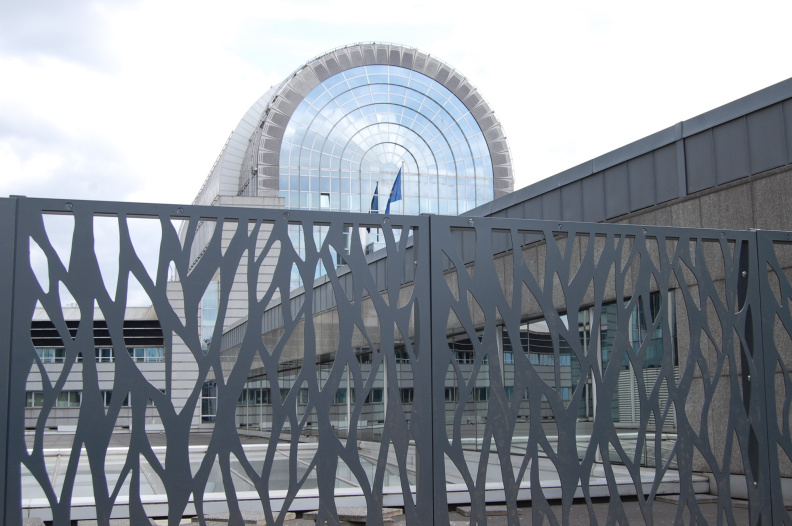
Railing presented with the LOVE TREE motif
Where should you install an elevated terrace?
A raised terrace can be built in various locations depending on preferences and the building's possibilities. An outdoor terrace adds character to the home and increases its perceived value. The terrace railing will be a decorative feature that complements the project, which is why it is important to choose the right options and finishes using the custom railing configurator.
On the roof of a building or house, flat or slightly sloping roof surfaces can be converted into elevated terraces, offering panoramic views of the surrounding area and sometimes breathtaking sunsets. Above a garage or parking space, if space allows, a rooftop terrace can be built to maximize the use of outdoor space accessible from the main building.
By working on the landscape and leveling the ground, it is also possible to create a raised garden. An elevated terrace can be built in an overhanging garden to create a relaxation or entertainment area above ground level. The feeling of being up high is pleasant and helps air circulate around the house.
When too much earth needs to be moved, a raised deck can be built on a pile structure to create an outdoor space sheltered by a deck railing.
Why add a terrace to a building?
A rooftop terrace offers several advantages that make it an attractive addition to a property. Despite the significant construction costs and technical expertise required to ensure a waterproof and safe terrace, many architects choose to add this extra space to their projects for the following reasons:
- Being located at a height, a terrace generally offers a panoramic view of the surrounding area, which can be particularly pleasant in areas with picturesque or urban landscapes. In this case, a Mosaïque Ergot perforated sheet metal railing is perfectly suited because its honeycomb pattern allows the eye to see all the way to the horizon.
- By building an elevated terrace, you can maximize the use of available outdoor space, creating additional space to relax, entertain, or welcome friends. The terrace provides access to an extra room in the house.
- A terrace high up in a building offers a high level of privacy and tranquility. By distancing themselves from the street and traffic, occupants are shielded from prying eyes and street noise, as is the case with this terrace in Paris's 6th arrondissement, which features a modern mashrabiya.
- Being higher up, a rooftop terrace often benefits from better air circulation, which can be refreshing on hot days and allow you to enjoy the outdoors more, as demonstrated by this project on a rooftop terrace in Brussels, protected from falls by a metal guardrail from the 9th floor of the European Parliament.
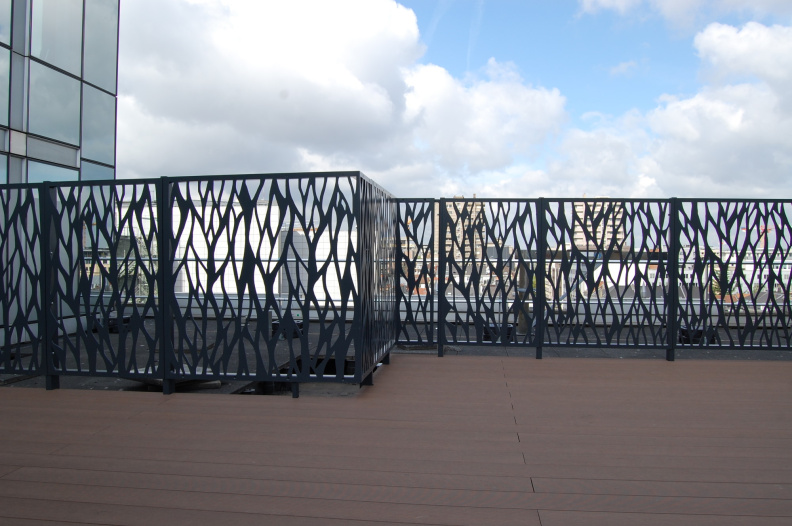
- A raised terrace can add aesthetic value to a property, creating an attractive focal point and enhancing the overall appearance of the outdoor space. This is why real estate agents emphasize the 20 m² terrace and always show photos of the terrace and its railing at the beginning of their presentation.
- A raised terrace can be designed in various ways to meet different needs, whether for outdoor dining, group work, yoga sessions, or simply relaxing. The terrace is a living space in its own right, as you can see in the terrace designed for the Belle Rive Clinic with a full-height metal mashrabiya, serving as a relaxation area, meeting place, reception area, smoking area for a public place, or break area for staff.
What is the difference between a terrace and a furnished balcony?
Technically, the differences between a balcony and a terrace lie mainly in their design, location, and structural characteristics, which result in different material choices and appropriate railing selections:
First of all, a balcony is generally an outdoor platform located outside a room in a building, often above the ground floor. It is usually supported by beams or brackets and is often attached to the building without touching the ground. Balconies are spread across different floors of a building, whereas terraces are platforms that are usually built at ground level or slightly raised above ground level. In a real estate project, we find several small balconies and one larger terrace. Balconies are therefore more common than terraces.
Balconies are generally smaller in size, designed to accommodate a few people at a time and provide space to stand or sit. In some cases, they are even referred to as balconets, a term used to describe small balconies.
Terraces, on the other hand, tend to be larger in size, offering enough space for activities such as outdoor dining, leisure, or relaxation. They can also be more robust in structure to support heavier loads. It is this difference that distinguishes a rooftop terrace, a relaxation terrace, or a smoking terrace. The same does not apply to a balcony railing.
Due to its size, a balcony is often accessible from inside the building via a French window or a single door leading to the outside. A terrace, on the other hand, may have several access points, including from inside the building, but it may also have direct access from the outside via a straight staircase leading to the terrace of a panoramic restaurant. In the case of terraces for public places, there are multiple access points, both to differentiate between staff and visitor traffic, but also to provide additional emergency exits.
Structural details of the terrace and choice of materials
Terraces can be classified into several categories based on their location, structure, and style. It is important to understand how they work in order to determine the type of terrace railing to install.
The suspended terrace is the simplest type. Built high up, this terrace is supported by posts or support structures and often offers spectacular views of the surrounding area. It can be fitted with laser-cut mashrabiya railings for a modern, transparent look. It is often decorated with flower pots, greenery and wooden furniture. By choosing plant-inspired designs from the Aurelius Roc railing or floral themes from the Roseaux railing, you can create a design that blends in perfectly with your terrace.
A rooftop terrace is the most common type of outdoor space, and does not require a building permit if the surface area is less than 20 m². Located at the top of a building or house, this terrace often offers a panoramic view and can be furnished with garden furniture, plants, and sometimes even a relaxation area or barbecue corner for the family or a limited number of people. Please note that if you are installing a heavy object such as a jacuzzi, you will need to provide support pillars capable of bearing a point load of 1.5 tons, as the terrace could collapse if the structure is not calculated correctly. For privacy reasons, you will need to choose a railing that blocks the view of your neighbors but allows you to see the landscape while you relax. The terrace railing configurator options allow you to customize the pattern, transparency, and color so you can see without being seen. For a Jacuzzi or spa installation on a terrace, we recommend the Striller Zen 9010 White guardrail, which is also available as a 2-meter-high privacy screen if you need more protection.
When it comes to a roof terrace, always check the waterproofing requirements before installing the guardrail to avoid the risk of water infiltration.
Made of wood, this deck adds a warm and natural feel to the outdoor space. It is raised on concrete, wood, or even steel support beams and offers a variety of designs, styles, and finishes.
Wood is a popular choice for elevated decks because of its natural warmth, beauty, and versatility. Hardwoods such as teak, ipe, or oak are particularly suitable because they are resistant to weather and winter conditions. When installing a guardrail on a wooden deck, always make sure to attach it to a load-bearing beam! Never attach it to a wooden slat, as these are too light to withstand the pull-out load of an anchor bolt. In addition, during periods of rain or snow, wood can swell with water and lose all its mechanical strength.
Concrete is a robust and durable material that can be used to create a modern and contemporary elevated terrace. It can be poured on site or installed in the form of prefabricated slabs and can be customized.
Several floor finishes are available for concrete terraces:
– Solid raw concrete with a variety of finishes, such as smoothed concrete, broom-finished concrete, or polished concrete. In addition, floor paint is a way to color the concrete of the terrace to give it a particular shade.
– Tiles are a versatile option for covering concrete slabs on elevated terraces, offering a wide range of patterns, colors, and textures. Ceramic or porcelain tiles are durable, weather-resistant, and easy to maintain, which is why tiles are often the solution chosen by our customers.
– Built with materials such as natural stone, terraces offer durability and weather resistance. They can be laid out in different patterns and textures to create a unique and elegant look. Natural stone such as travertine, sandstone, or granite can be used to create an elegant and timeless raised deck. Stone offers exceptional durability and a variety of colors and textures to suit different design styles. It is slightly more expensive than tile, but offers unmatched quality and appearance.
– Outdoor wood decking tiles measuring 50 x 50 cm or 100 x 100 cm can be used to complement the concrete design. In addition to a smooth concrete finish, wood decking allows you to customize the layout of your patio.
Which guardrail should you choose depending on how you use your terrace?
A raised terrace can serve a variety of purposes depending on the building's needs. Here are some examples of common uses for a raised terrace for which we have adapted the choice of guardrail:
- Relaxation area: An elevated terrace can be designed as a relaxation area where occupants can unwind, read a book, sunbathe, or simply enjoy the view. When it comes to decorating a relaxation terrace, anything goes. The railing will depend on your inspiration and the atmosphere you want to create in your relaxation area.
- Entertainment space: A rooftop terrace can also be used as an entertainment space for hosting guests, barbecues, outdoor dinners, or parties. Whether used as a smoking area or rooftop bar, the terrace can serve a variety of purposes. In this case, it is important to have a sturdy, impact-resistant guardrail as prescribed in the NF-p-01-013 guardrail standard and to ensure that it is easy to clean between events. Glass guardrails should therefore be avoided due to the risk of smudges and stains, and metal guardrails such as Opale Génius, which can be easily cleaned with clear water, should be preferred.
- Potted garden: For gardening enthusiasts, a raised terrace can be transformed into a potted garden where potted plants or planters can be arranged to create a green and pleasant space. The Opéra Parons railing is practical for hanging flower pots at different levels, from 12 inches to 24 inches and then 40 inches to completely cover the height of the railing.
- Outdoor workspace: For those who work from home, a rooftop terrace can be converted into an outdoor workspace, providing an inspiring and refreshing environment in which to carry out professional tasks. A Lones guardrail Lones a beautiful finishing touch to the terrace, combining transparency, opacity, and a dynamic vertical effect for more productive work.
- Fitness area: An elevated terrace can be used as an outdoor fitness area where you can exercise, do yoga, stretch, or engage in other physical activities while enjoying the fresh air and sunlight. The Agréga guardrail combines contrast and dynamism.
Technical summary of the terrace guardrail
- Terrace barrier with decorative pattern, standard size 100 cm high from the finished terrace floor to the top of the handrail, adjustable from 50 cm to 120 cm above the low wall and depending on the configuration of the terrace.
- Privacy panel with different handrail heights: 50 cm, 55 cm, 60 cm, 65 cm, 70 cm, 75 cm, 80 cm, 85 cm, 90 cm, 95 cm, 100 cm, 105 cm, 110 cm, 115 cm, 120 cm, installed on the terrace floor for easy installation.
- Sheet metal covering to cover the slab up to a maximum size of 25 cm in order to conceal black flow marks around the edge of the terrace.
- Guardrail compliant with standards NFP01012 and NFP01013 to ensure safety in private areas at height or at risk of falling.
- Sheet metal designs for perforated or laser-cut sheet metal bases are available in various graphic styles via the Dampere configuration tool.
- Decorative metal panel with standard patterns, random round holes, square cutouts, vertical spindle openings, degressive patterns on the railing elevation, graphic shapes and designs, floral patterns, moucharabié panels to fill the terrace railing structure.
- Recommended transparency level for terrace guardrail performance: 5% to 40% empty space.
- Choice of colors and finishes in powder coating available in all shades of the RAL color chart.
- 90-degree terrace corner layout, symmetrical on both sides for a balanced appearance. Corner returns can be adapted to the site, with custom processing at specific angles, such as 70 degrees, 80 degrees, 100 degrees, 110 degrees, and 120 degrees, to meet the aesthetic and structural requirements of the project.
- Discreet assembly with countersunk blind rivets.
- Aesthetic uniformity of the terrace railing along its entire length, offering a panoramic and personalized view of the landscape.
- Dynamic impact resistance test performed at the customer's request, according to the sandbag constraint.
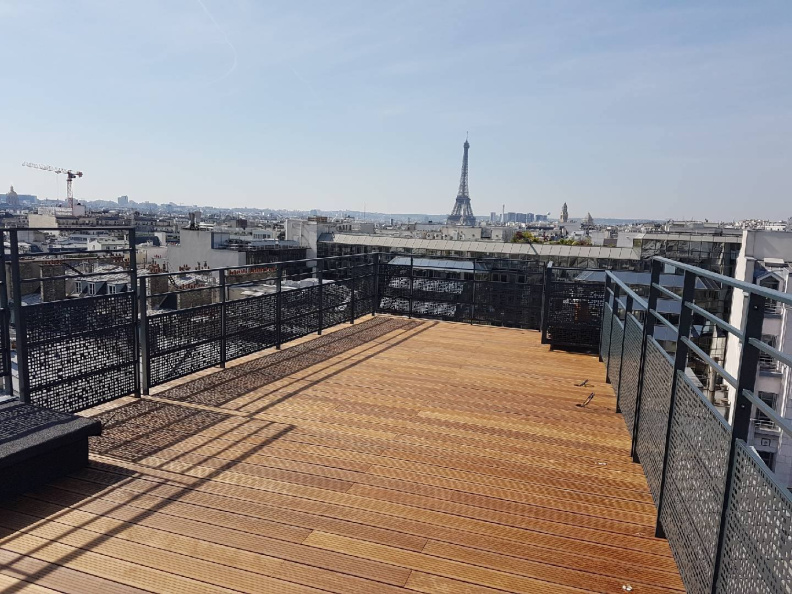
The terrace railing system offers a multitude of patterns in various graphic arrangements, allowing you to create abstract decorative themes and plant and flower-inspired metal trellises to embellish your terrace. The openwork panels and support posts are available in a range of coordinated colors, ensuring a consistent and elegant aesthetic, both from inside the terrace and from the street. Powder coating is included in all RAL colors, adding a touch of finesse at no extra cost. Special color options are also available to suit your particular preferences and contrast beautifully with the colors of your decor. We recommend the use of galvanized steel for its corrosion resistance and durability in the specific context of the European climate. In addition, savings can be made on large-scale projects, making our terrace railing system not only aesthetically pleasing but also economically advantageous. By partially or completely covering the slab edge with modern designs, our railing can transform your terrace into a harmonious and elegant space.
Description of the terrace railing
The terrace railing system, designed by Dampere, stands out for its subtle and elegant integration into a raised terrace, ensuring a harmonious and refined aesthetic from both the street and the interior of the terrace. Thanks to its clever design, it effectively conceals all objects on the concrete terrace, creating a visually consistent and refined appearance across the entire structure. In addition, this aesthetic feature contributes to an impeccable finish while preserving the structural integrity of the metal railing.
The terrace railing, designed by Dampere, offers a secure solution for elevated spaces while enhancing their aesthetics. By concealing the edge of the concrete slab up to a height of one meter with attractive decorative patterns, it adds an extra touch of elegance to the project. The railing's sturdy metal fasteners ensure a harmonious boundary around the terrace on the concrete slab. Its unique decorative panel creates visual continuity from the top of the handrail to the ground, ensuring a consistent aesthetic. With a variety of patterns and textures available, it allows for an original and fluid design for a modern and continuous terrace. Its modular installation method, suitable for all site configurations, offers great flexibility. The terrace railing kit can thus be customized to meet the specific requirements of each project, with height-adjustable fasteners for optimal installation.
Technical details of the terrace guardrail in the CCTP
Specific Technical Specifications for Guardrails
Metalwork – Balcony protection with terrace guardrails
1/ Description of the Terrace Guardrail
The Terrace Guardrail System, made of welded steel tubing in standard dimensions of 120 x 100 cm (distance between posts x handrail height), provides robust protection against falls from balconies. The standard spacing between modules is 120 cm, with a margin of 3 to 8 mm to adjust the alignment during installation. The total height of the guardrail, measured from the most protruding point of the tile on the slab to the handrail, is 100 cm. The custom cut pattern is determined by the architect from the range of decorative patterns offered by Dampere, with a product-specific reference code.
2/ Material and Finish
The terrace railings are made of galvanized steel to ensure optimal strength and durability, even in extreme weather conditions, to be specified when ordering. A powder-coated finish is applied to all parts in the same RAL color, chosen by the architect to ensure aesthetic uniformity. The corners of the terrace are designed with modular elements integrated on each side of the concrete slab, eliminating the need for central supports. The main angle is 90 degrees, but it can be adjusted to different configurations, offering maximum adaptability while maintaining a consistent and secure aesthetic.
3/ Available Sizes
The height of the posts varies according to the project requirements, with options available for parapet walls and raw slabs. To prevent dirt accumulation, the slab cover can be made with different levels of overhang, ranging from 0 cm to 25 cm. Customized options are also available according to specifications provided by Dampere.
4/ Delivery and installation of the guardrail
Terrace railings are delivered according to the required specifications and installed in accordance with DAMPERE recommendations, taking into account the specific features of each site to ensure optimal installation.
Advantages of terrace railings
The benefits of quick installation on terraces and the concealment of objects on the slab are the essential pillars of the Dampere Terrace Guardrail system. Applied according to the Parefit or Paredam guardrail system, metal decoration plays an important role in terrace design projects:
Discover the unparalleled advantages of the Laser Cut railing system for your deck:
1. Enhanced Security and Modernized Aesthetics:
– Our system provides decorative cladding coverage along the entire length of your terrace, ensuring protection against falling objects from heights of up to 1 meter. In addition to guaranteeing your safety, this decorative metal solution will transform the appearance of your terrace, giving it a modern and transparent look.
2. Integrated Balcony Slab Protection:
– Thanks to its innovative design, our system provides optimal protection for the thickness of your balcony slab. Installed at the edge of the concrete slab, it offers a uniform and neat finish, thus preserving the structural integrity of your outdoor space.
3. Wide Range of Custom Designs:
– With a variety of decorative patterns, ranging from botanical to abstract, our system allows you to create a unique architectural ensemble, suited to all types of buildings and all project sensibilities. Give free rein to your creativity and customize your terrace according to your aesthetic preferences.
4. Simplified and Robust Installation:
– Installing our modules is child's play thanks to a secure connection between the post and the panel, secured with mechanical screws. This robust fastening guarantees a long-lasting installation, offering long-term peace of mind.
5. Fully adaptable to your deck configuration:
– Each panel can be individually adjusted during installation, offering total flexibility to align perfectly with the specific features of your balcony configuration. Our system adapts to all terrace shapes and project sizes, allowing you to customize your outdoor space according to your needs.
6. Customization and Ease of Installation:
– Our parts are numbered and custom-designed, ready to be installed quickly and efficiently on your wooden deck or concrete balcony. Simplify your assembly process while benefiting from a tailor-made solution for your project.
Compliance of terrace guardrails with standard NFP01012
In accordance with the safety guidelines established by NFP01012 standards, the terrace guardrail features a sturdy module topped with a solid handrail, fixed at a standard height of 1 meter, ensuring optimal protection against falls from a terrace. Rigorously tested under dynamic impact conditions, this device guarantees maximum strength and reliability, meeting the requirements of residential environments such as houses, apartments, or collective housing, as well as spaces regulated by labor laws. In addition, it is specifically designed to resist expansion, ensuring long-term stability in the face of seasonal temperature fluctuations. Compliant with the most stringent safety standards for balconies in apartment buildings and individual terraces, the Dampere guardrail Dampere an effective barrier against the risk of falls for people, pets, and objects. Its design incorporates elements that deter climbing, offering additional protection, particularly for young children, thanks to an openwork sheet metal design that makes it difficult to gain a foothold, thus preventing any attempt to climb or position oneself precariously. Depending on the level of risk identified, it is recommended to choose a fine mesh or a very tight mesh mashrabiya to prevent any attempts to climb.