
Guardrail Standard NF P01-012
The NF P01-012 guardrail standard is a French standard that establishes safety requirements and testing methods for guardrails used in buildings and public spaces for which we supply our products and services. This standard aims to protect people from the risk of falling from heights, such as balcony guardrails, terrace guardrails, stairs, mezzanines, loggias, or upstairs galleries, which is why we pay close attention to it in each of our projects. Guardrails that comply with this standard must be designed and installed in such a way as to withstand specific loads and provide an effective mechanical barrier against falls. They must also be made from suitable materials and meet durability and strength criteria. The NF P01-12 standard guarantees that guardrails are safe, reliable, and comply with current safety standards.
Dampere customization Dampere guardrail designs and dimensions must always comply with the NF P01-12 standard. The dimensions of custom-made guardrails must ensure the protection of your balcony in all situations. This is the objective of this standard, which applies to guardrails in residential buildings and establishments open to the public. The work of Dampere design office Dampere of continuously adapting product characteristics to maintain compliance with the NF-P01-012 guardrail standard. Despite our wide range of possibilities, we restrict our options to compliance with current safety standards whenever we offer customization of guardrails for a customer's project. All adaptations on the configurator are restricted to the scope of French, Belgian, Luxembourgish, and Swiss standards.
Basic rules to remember for standard NF P 01 012
Main rule of standard NF P 01-012: Height of guardrails
The main rule of standard NF P01-012 concerning the height of guardrails stipulates that the minimum height must be at least one meter (1 m) or 1000 mm from the ground to the top of the handrail. This refers to the finished floor, including screed, adhesive, and tiles or any other floor covering such as wooden slabs or decking. This measure aims to ensure adequate protection against accidental falls from balconies, terraces, stairs, and other elevated areas in buildings. By maintaining a minimum height of 1 meter, the standard aims to prevent people from tipping over or falling over the guardrail. This rule thus helps to ensure the safety of building occupants by reducing the risk of serious injury or death due to falls from height.
Important rule NF P 01-012 standard: Guardrail safety zone
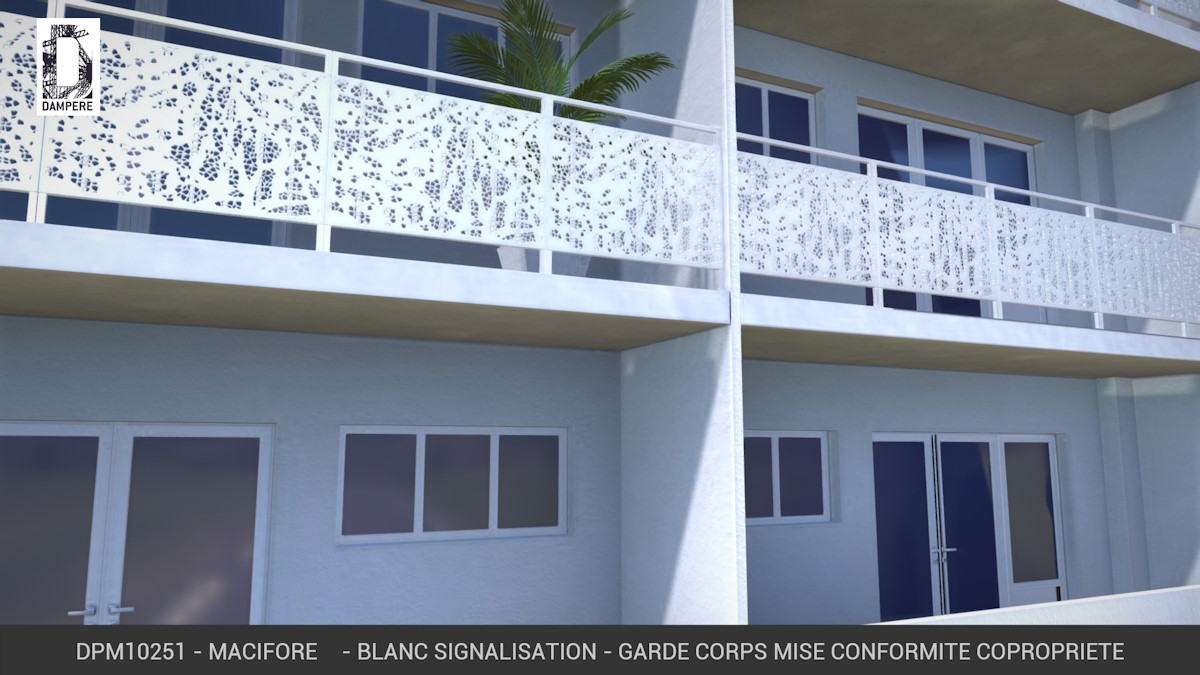
A safety zone of 45 cm or 450 mm must be provided at the bottom of guardrails. This protective zone is measured from the finished floor to a height of 45 cm inthe absence of precarious support.
The 45 cm base area is clearly established in standard NF P01-012, which stipulates that the lower part of the guardrail, up to a height of 450 mm from the ground or concrete slab, has a dual purpose. The safety zone must first be designed to prevent objects from passing through or falling. Secondly, this 45 cm protective space deters any attempts to climb over. This horizontal protective zone can be created using more opaque panels, tightly spaced laser-cut patterns, or decorative perforated sheet metal.
Key rule NF P 01-012 standard: Vertical space between guardrail bars
The vertical space between the bars of the guardrail, generally set at 11 cm according to standard NF P 01-012, is a regulatory measure designed to ensure the safety of occupants while preserving the aesthetics and functionality of the guardrail. The 110 mm measured between two vertical spindles, vertical tubes, but also from the finished wall to the first post of the guardrail, leaves a space greater than 10 cm between the concrete facade and the safety module.
This 11 cm rule prevents accidental falls by limiting the space between bars. The NF P01-12 standard aims to prevent young children and pets from accidentally passing through the vertical bars of the guardrail.
Basic rule NF P 01-012 standard: Horizontal spacing between guardrail rails
The NF P 01-012 standard specifies the horizontal spacing between guardrail rails as 18 cm or 180 mm. This safety measure is important to protect occupants from falling from balconies, terraces, or mezzanines. As a reminder, the 18 cm horizontal spacing between the rails is designed to prevent young children and pets from passing through the guardrail, thereby reducing the risk of accidental falls from a great height. Placing your foot on a horizontal bar makes it easy to climb, especially if there are other horizontal bars to hold on to for stability. Be careful, as children can easily climb on a guardrail when playing in a very risky manner.
This measure complies with safety standards established for guardrails, which aim to protect occupants from hazards associated with heights. By adhering to this spacing, designers and installers ensure that the guardrail provides adequate safety.
Understanding standard NF P 01 012
What are the outlines of standard NF P01-12? What is not expressed in the standard, but must be understood through its application by inspection agencies and the choice of project owners?
A standard is primarily used to establish criteria, specifications, and guidelines to ensure the quality, safety, and compatibility of products and services. The aim is to ensure the quality and reliability of guardrails, as standards generally define stability requirements and performance criteria for products, guaranteeing their reliability and compliance with user expectations. The NF P01-12 standard deals with guardrails for residential buildings and establishments open to the public, addressing the topics in a generic manner.
The standard establishes safety requirements for products, equipment, and infrastructure, thereby reducing the risk of accidents and damage to people and property.
However, the standard does not go into detail about every situation or every application. When it comes to children, play areas, or people with physical or mental disabilities, additional precautions must be taken. The same applies to areas prone to turbulence or vandalism. Only the project owner and architect, assisted by design offices and an inspection office, can adapt the guidelines to be applied specifically to ensure people's safety.
The NF P 01-012 standard does not provide specific guidelines for nurseries, preschools, daycare centers, playgrounds, recreation centers, schoolyards, let alone middle schools or high schools, or for places involving psychosocial risks or establishments that may accommodate people at risk. It is necessaryto adapt the height of the guardrail, reinforce the safety zone by 45 cm, close the space between the concrete slab and the bottom rail of the guardrail, prevent climbing, and ensure that there are no finger traps for young children. These choices can only be made by the building owner, tenant, or lessor. The adaptability of the guardrail configurator allows you to adjust your product to precisely meet your needs, as each construction site is different and the constraints are specific to the project.
Anti-climb rule for guardrails at risk
An important rule in standard NF P 01-012 concerns the anti-climbing zone of the guardrail. This rule aims to prevent any attempt to climb the guardrail, particularly by children or people with psychological risks. In order to reduce the risk of accidents and ensure the safety of occupants, the guardrail must be designed in such a way as to effectively deter any attempt to climb it. In some cases, anti-climbing protection must be reinforced by making several adjustments to the guardrail:
- The minimum height of the guardrail is specified to prevent anyone from easily climbing over or scaling it, taking into account all risks of unstable support. For example, a child is capable of moving a plastic stool to use as support or placing a toy truck at the bottom of the guardrail. In this case, the height of the guardrail must be increased to 110 cm or 120 cm, depending on the situation. The 120 cm high guardrail is a standard feature of the Parefit or Paredam range to increase child safety against the risk of falling.
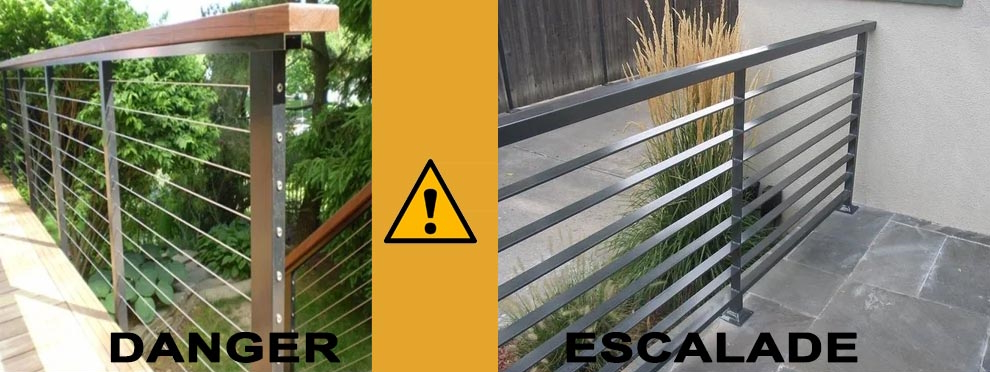
- The railings, whether perforated metal, laser-cut panels, metal latticework, bars, or glass, must be designed so that they do not provide easy handholds for climbing. High horizontal rails should therefore be prohibited to prevent easy grip and increase the safety zone from 45 cm to 60 cm.
- No part of the guardrail should be easy to grab onto, which could encourage someone to try to climb over it.
- The guardrail must be sufficiently rigid and strong to withstand significant lateral pressure without deforming or yielding, which could potentially facilitate climbing. Therefore, avoid stainless steel cable guardrails, which can gradually loosen.
In summary, the rules proposed by Dampere the anti-climbing zone of guardrails aim to deter any attempt to climb by designing the guardrail in such a way as to make this action difficult, if not impossible, while ensuring its primary function of protecting against falls.
Anti-climb rule for guardrails
The primary rule of standard NF P 01-012 concerns the vertical space between the bars of the guardrail AND the horizontal interval between the rails, with both parameters combined to provide protection against climbing over the guardrail. The two criteria combined give a volume of 11 x 11 x 11 cm, which must not protrude beyond the surface of the guardrail. This information is important for laser-cut guardrails, but also for wrought iron and antique cast iron elements.
The vertical space between bars of 11 cm or fixed at 110 mm is a crucial measure to ensure the safety of occupants, especially children who could get their head or leg stuck in it. This specification aims to prevent the risk of accidental falls through the guardrail by limiting the size of the spaces between the bars. This measure is particularly important in residential areas where children may be present and constant supervision is not always possible.
Anti-finger trap rule for guardrails
The anti-finger trap rule is not written in standard NF P 01-012, but it is part of the conditions of use for guardrails in places that accommodate children. The anti-finger-pinching rule applies to nurseries, daycare centers, preschools, and kindergartens. The problem of finger pinching in nursery guardrails refers to the possibility of children's fingers getting stuck or pinched between the components of the guardrail or in a hole in the openwork metal plate. Children, due to their natural curiosity and lack of awareness of dangers, may be prone to inserting their fingers into the spaces between the bars, rails, or other parts of the guardrail. If these spaces are too wide or poorly designed, it can result in injuries, pinching, or cuts to children's fingers. Expanded metal should not be used in any place where children are present, as the risk of finger pinching injuries is ever-present.
For all these reasons, it is essential to design nursery railings in such a way as to minimize this risk by complying with the appropriate safety standards, ensuring that the spaces between the railing elements are narrow enough to prevent children's fingers from passing through.
Filter barrier rule for guardrails
The filter barrier rule for guardrails aims to prevent objects from passing through the spaces between the guardrail components. It is designed to prevent objects such as toys, tools, or other items from accidentally or intentionally passing through the openings in the guardrail, which could result in injury or damage to people at the foot of the building or on the sidewalk. This code of conduct stipulates that the spaces between the bars, rails, or any other component of the guardrail must not be wide enough to allow a standard-sized object to pass through, the application of which varies depending on the purpose of the building and the risk involved. Thus, there will be a difference in assessment between an object falling from the first floor or the fifth floor, as well as between a residential building and a nursery, as the level of supervision will not be the same.
By applying this principle in every case, we create an effective barrier that ensures the safety of occupants while maintaining the attractive and functional appearance of the guardrail.
Finally, here are five best practices for child-proof railings:
- Do not use expanded metal, welded wire mesh, or cable for a nursery school.
- Use perforated sheet metal for guardrail infill to extend the safety zone by 45 cm and prevent climbing.
- Avoid horizontal rails and any supports that could provide unstable support.
- Seal the lower part of the guardrail to prevent objects from passing through.
- Allow the view to pass through to prevent the child from trying to climb up to see what is behind the visual barrier of the guardrail.
Compliance of the Dampere guardrail Dampere standard NF P 01-012
Compliant with the most stringent NF-P-01-012 safety standards, the Dampere guardrail Dampere safety first. Its sturdy handrail is positioned at a standard height of 1 meter, which can be adjusted to 1.2 meters or 120 cm depending on the project requirements. The Dampere guardrail provides optimal protection against falls from balconies.
The expression "produire en bon père de famille" (produce with due diligence) applies to the design of the Dampere guardrail, referring to the idea of managing or acting with care, diligence, and foresight based on technical reasoning and prudence acquired in similar circumstances. It involves making decisions and taking actions in accordance with accepted standards and practices in order to minimize risks and protect the interests of our customers and users of the guardrail. To help us do this, we need to understand the circumstances and constraints of the construction site.
The design of the DAMPERE guardrail DAMPERE into account the expansion of the building, ensuring long-term stability in the face of temperature variations. The materials chosen are durable, environmentally friendly, and recyclable. Designed to meet the most stringent standards, it effectively prevents the risk of falls, both for people and objects. Its design incorporates elements that deter climbing, offering additional protection, particularly for children, thanks to perforated sheet metal that prevents any attempt to climb or stand in an unstable position. In addition, its increased resistance to vandalism guarantees its durability and long-term effectiveness, whatever the environment.
Whether the guardrail is easy to install, quick to install, or an express guardrail version, the balcony protection kits comply with the NF P 01-12 standard.
Guardrail compliant with NF P01-013 standard
The NF P01-013 standard specifies mechanical tests for guardrails and stair railings, as these safety devices must be able to withstand high pressure to prevent the risk of falls. The risk of falling is assessed in relation to a moving body, moving in an unbalanced manner, either when crossing a staircase or in a falling movement when tripping on a step or losing balance on the obstacle of a sliding rail on a French window. The weight of an 80 kg person who falls without being able to hold on can be impressive.
Standard NF P 01-013 establishes the static or dynamic tests that apply to guardrails defined in standard NF P 01-012, as well as the acceptable deformation tolerances for each of these tests.
All tests carried out on Dampere guardrails Dampere with standard NF P01-013 for residential, administrative, commercial, educational, industrial, and agricultural buildings, as well as all other buildings open to the public.
The tests that are carried out therefore make it possible to test the resistance of guardrails in the event of a fall or strong pressure by:
- static tests Horizontal outward
- static tests horizontal inward
- Dynamic tests on soft-body impact guardrails.
Static test on guardrails NF P 01-013
A static mechanical test for guardrails involves applying a constant or progressive force to assess the strength and stability of the system. This determines the guardrail's ability to withstand vertical or lateral loads without deforming or failing.
Dynamic test on guardrails NF P 01-013
A dynamic mechanical test on guardrails involves subjecting these structures to variable loads over time to assess their resistance and behavior when subjected to dynamically applied forces. This makes it possible to verify the guardrail's ability to withstand unexpected loads or moving stresses, thereby ensuring its safety and reliability in real-world conditions.