
Balcony sheet metal railing
Balcony protection is a priority for ensuring the safety of a building. Balconies cannot remain without fall protection, regardless of the height of the building. From a fall height of 1 m or 100 cm, the standard for balustrades requires the installation of protection. It is therefore necessary to install perimeter safety measures in the form of a metal balcony railing to prevent the risk of falls, which are all the more dangerous if the balcony is located at a great height. When renovating a building's facade, it is also necessary to ensure that the old guardrails comply with regulations, as they are often not high enough or have bars that are more than 11 cm apart.
Metal railings remain the most commonly used barrier for safety purposes. Below you will find explanations of the different uses of these products for both balconies and terraces, as well as the types of buildings for which metal railings are commonly used. Unsurprisingly, whether for collective housing, social housing, individual housing, lofts, modern villas, or apartments, the same protection remains functional for safety railings. Naturally, the idea of protecting against the risk of falling logically implies that the risk of climbing over the protective barrier must be avoided. To do this, you must avoid having a small concrete step in front of the sheet metal balustrade, a flower box, or any other type of sheet metal balustrade infill that allows a foot to be placed on it and then another, thus creating a climbing hazard that you must absolutely prohibit for young children who do not understand the risk and see it only as a climbing game.
As each project is different in nature and design, it is necessary to create a custom-made perforated sheet metal balustrade to fit the dimensions of a balcony, both in terms of its length and its angles or returns. The guardrail must be positioned as far forward as possible from the outer edge of the balcony to maximize outdoor living space. Technical adjustments must take into account the thickness of the concrete slab, its strength, and the position of the anchor points for the mechanical dowels without weakening the concrete's load-bearing structure. When renovating a balcony with a sheet metal balustrade, the age of the building and any cracks must be taken into account when positioning the new mechanical anchors in the slab, avoiding areas of the concrete slab that have been cracked by weathering.
The composition of a custom-made sheet metal balustrade is all the more important because each balcony will be different depending on the position of the fixing points available during renovation.
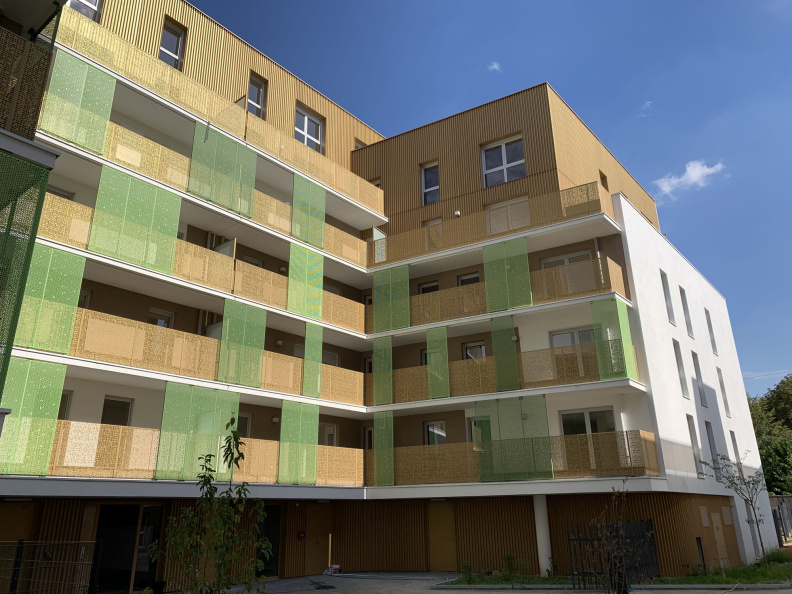
Custom sheet metal balustrade
The sheet metal railing serves as close protection against a definite risk of falling.
To do this, it must be securely installed on the balcony, but at the same time on the outer edge of the balcony to avoid losing space, as we mentioned earlier. The balcony area is part of the leisure and relaxation space available in an apartment. Some balconies are limited to 4 m², and in some large cities, the balcony area is barely 2 m² due to lack of space. The reduced size does not detract from the pleasure of opening a double French window to step outside and enjoy the hustle and bustle of the street. The feeling of freedom that an apartment balcony offers is irreplaceable, which is why some real estate ads place so much emphasis on the presence of a balcony in their property listings.
In many cases, balconies are part of the building's graphic design, and their presence alone distinguishes the building's facade. They come in surprising shapes and sizes, sometimes with triangular, trapezoidal, or rounded designs. These balcony configurations require custom-made sheet metal balustrades to best meet the needs. For cost-saving reasons, standard sheet metal balustrade modules are first produced in standard, repetitive formats based on the factory template. Then, to fill in the gaps, we add custom sheet metal balcony modules to ensure complete protection, resulting in an optimized balcony with metal protective elements that are tailored and adjusted to the exact dimensions, down to the centimeter.
Using the custom sheet metal balustrade configurator, you can finely tune the size of each balustrade module to match the dimensions of your personal balcony project as closely as possible. Try out its simplified online use, which will give you results in just a few clicks.
For balconies with a low wall, we supplement the remaining height with a metal structure to complete the 1 m protective height at handrail level. This is a balustrade configuration that can be adapted to the height of the low concrete wall.
Perforated sheet metal balustrade
The concept of perforated sheet metal balustrades has become increasingly common in Europe since the introduction of strict regulations on the risk of falling and climbing. With the harmonization of rules on precarious supports through European standards, perforated sheet metal has become an important choice for architects, meeting European regulations, economic considerations, and aesthetic requirements. Fundamentally, galvanized steel perforated sheet metal balustrades offer better environmental performance than any other solution available in the building industry. A comparison of the amount of CO2 emitted or energy consumed shows that perforated sheet metal balustrades are far ahead of glass and aluminum balustrades. When comparing price or cost savings, perforated sheet metal balustrades are on a par with aluminum balustrades or balustrades with verre transparent infill, with variations depending on the ranges and models offered by each manufacturer. The application of CSR in construction encourages the use of perforated steel sheet balustrades because they are economically viable, socially equitable, and environmentally tolerable compared to all other materials: concrete, aluminum, glass, etc.
French installation or English installation? The standard size of perforated sheet metal balustrades is 1000 x 1200 mm, but this can be adjusted according to the requirements of the project for French installation (also known as installation on concrete slabs). The minimum size of the perforated sheet metal strip is 40 cm or 400 mm to comply with precarious support constraints, while the maximum size can reach 150 cm or 1500 mm in English installation to meet slab edge coverage requirements, especially if the terrace is covered with decking laid on pedestals. In some cases, the infill is used in a full-height version to become a privacy screen that hides the view from the neighborhood.
Perforated metal balustrades can be easily adapted to architectural projects thanks to the wide range of transparency and decorative patterns, colors, and shapes available, making them suitable for all styles of facades. With the many options available for perforated sheet metal, it is possible to create a multitude of graphic combinations using random perforated sheet metal patterns or perforated sheet metal with a plant effect, with light or dark powder coating, as well as a level of light transmission or visibility that meets the need for privacy on the balcony. Reed fencing is not a sustainable solution for a balcony. The best solution for protecting yourself from the gaze of neighbors is to choose the right level of transparency for the perforated sheet metal balustrade.
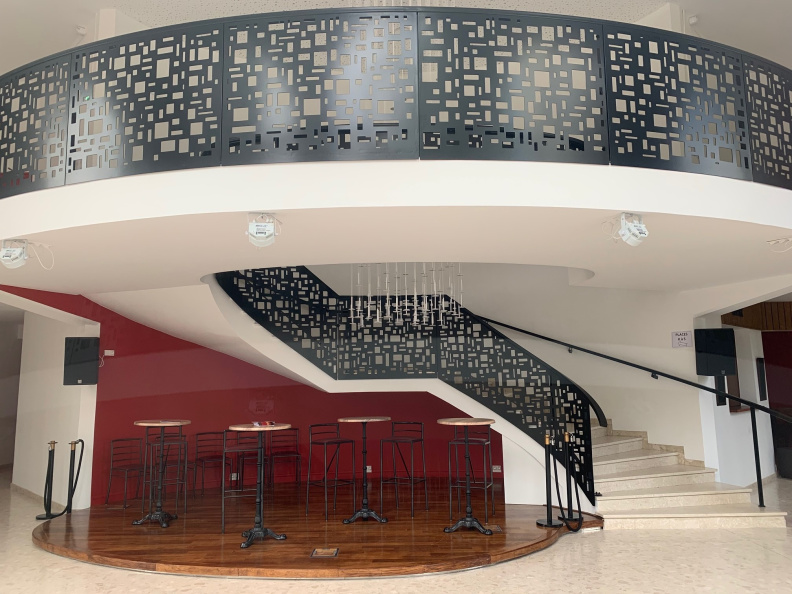
How to choose a railing?
The balustrade you install must match the style of the house. It is an element that is clearly visible from outside the house, sometimes from a great distance. Balustrades are part of the architectural signature of the building, which is why they must be carefully designed. It should be noted that from inside the apartment or house, the balustrade will be the first thing you see when looking out of your window.
A wide range of decorative fillings in perforated sheet metal and laser-cut decorative panels can satisfy all the architectural requirements of the house. Combined with a wide range of colors and varying degrees of transparency, this creates multiple combinations that will help you choose a balustrade.
Next comes the question of style: should the balustrade blend in with the building, or should a visible contrast be created to better highlight the architectural facade? It's up to you to decide.
Historical evolution from ancient balustrades to modern guardrails?
Since the beginning of this chapter, we have been using the word balustrade in parallel with the term guardrail. What is the difference between the two? We can discuss the difference between a guardrail, a balustrade, a railing, a safety barrier, etc. in broader terms. These terms are almost synonymous today, but there are still some differences. Let's dive into the etymology of the words to better understand them. Note that terminology in France today adapts according to usage: on a footbridge, we would say it is a handrail, on a staircase, it would be a ramp (also called a handrail), and on a bridge, we would refer to it as a guardrail. A balustrade that serves to secure the area where it is located is an openwork protection that allows light to filter through, as in the case of a balustrade installed on a balcony.
Although these words are similar, they actually have quite distinct meanings. Obviously, these four terms refer to an architectural element designed to protect and secure an elevated location, with structural, geometric, or sometimes cultural nuances.
Without a doubt, whether it is a railing, balustrade, guardrail, or even a safety barrier, these are always decorative elements that can add real character to both the interior and exterior of a building. The term "guardrail" is becoming increasingly common in architectural vocabulary when it comes to protection and safety today.
To better understand the history of guardrails, we must delve into the past to find the first traces in plans and accounts. A combination of increasingly efficient construction techniques that allow access to upper floors, shipbuilding that implements new boat designs, and the art of warfare that requires more suitable protection. Changes in terminology appear depending on the materials used, their purpose, the region of Europe concerned, and the language spoken. Even though the protective function of a railing has existed since the construction of the first wooden castles, this solid structure, raised above the palisade, served as fall protection for the guard tower, but also as protection against the first assaults.
Without attempting to place terms in chronological order or rank them in order of importance, here is an explanation of the various terms relating to balustrades and guardrails.
Origin of the railing and etymology
The term "railing" refers to a structure designed to protect individuals from potential falls, primarily on the gangway of boats. In the 15th century, the railing was actually a structure built at the bow that served as a platform for the fighters on a galley, which could hold up to thirty soldiers. The word railing has gradually given way to guardrail, including in the naval and military fields.
Be careful not to confuse the word railing with parapet, as the latter is always a solid wall. Indeed, a parapet refers to a structural element of a dense, solid wall designed to protect soldiers from enemy fire, so its mechanical strength is the primary criterion for evaluation.
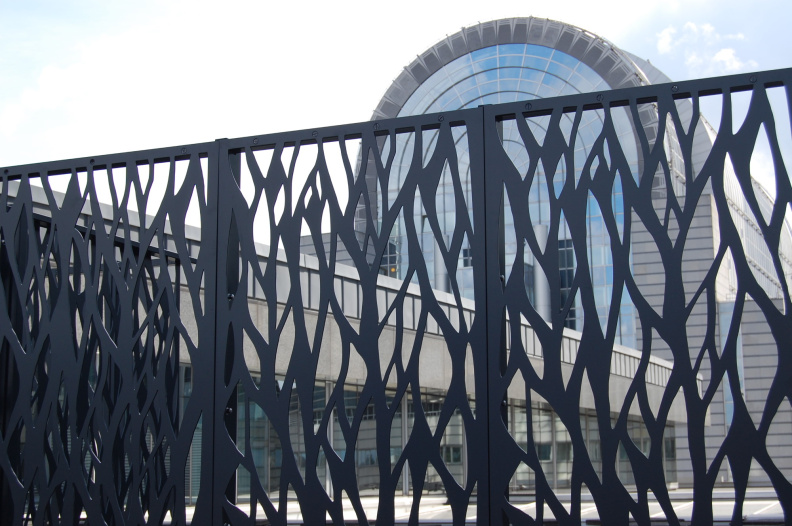
Description of the balustrade and origin
The balustrade is an ancient architectural element, with no connection to combat or the sea. Derived from the word baluster (a small shaped pillar), the balustrade represents a series or row of balusters in a row, fixed between a base and a shelf, which provides support. This architectural element was used as decoration in historic buildings such as churches, palaces, and even castles of yesteryear. It would be too complex to date its origin, but in the Middle Ages, certainly around the birth of Romanesque art, the first traces of vaulted architecture using solid balusters appeared.
During the Renaissance, in addition to its primary function of protecting against falls, the balustrade became an object crafted primarily for its aesthetic appeal.
To understand the original shape of the balustrade, let's look at its etymological origin. It comes from the Italian word "balaustro," meaning pomegranate flower, because each pillar resembles this flower with its bulge in the middle.
Origin of the guardrail
The Middle Ages saw the emergence of the term garde-faux, the etymology of which is difficult to trace: it refers either to the material used in its manufacture—beech wood, or fou in Old French—or to its spelling, which was then gardefol. The second meaning would be garde-faux, more oriented towards human anatomy, with the faux du corps referring to the fold of the torso at the waist. In the 13th century, garde-faux was a term used in clothing, with wardecors referring to a piece of armor protecting a soldier's stomach, and gardecors referring to an outer garment reserved for men but sometimes worn by women during long journeys. Then, in the 19th century, it became a nautical term referring to a barrier made of several rows of ropes, rails, or round iron bars, used to protect the deck, gangways, or masts of a ship.
In the 20th century, the meaning of the term changed to refer to a barrier located in prominent places above excavations to prevent the risk of falls. The term continues to evolve to refer to safety barriers along highways or winding mountain roads.
History and evolution of guardrails
The guardrail therefore has no connection with madness or insanity as described by psychiatric illness. It is in fact a protective element of military origin, which has evolved into the term guardrail in several European countries. The term "guardrail" refers to a marine term used to protect the deck of a boat or the gangways and mast of a ship, but it is also used in the construction of civilian buildings. It consists of posts supporting a handrail and a filling that completes the structure. These elements provide protection against the risk of falling and make guardrails an important safety feature. As such, they are used in various installations to secure your interior and exterior spaces. Over the centuries, guardrails have evolved in terms of their composition, architecture, and standards, but they have never lost their primary purpose: to prevent accidental falls. Guardrails are now designed to prevent them from being easily climbed or to prevent children from slipping through the spaces in a railing.
The different functions of guardrails
- Window guardrails: protect against falls when windows are high up, but also allow you to safely enjoy the view while leaning on the windowsill of an apartment.
- Terrace guardrails: delimit terraces designed at height, provide safety so you can relax on your terrace without worrying about objects falling; please note that guardrails are required for heights of 1 meter or more.
- Balcony guardrail: serves as a safety barrier to prevent accidental falls from the balcony.
- Stair railings: both indoors and outdoors, they delimit stair flights, serve as a guide when going up and down stairs, and reduce the risk of falling, mainly at the landing.
- Mezzanine guardrails: mandatory equipment for elevated spaces to eliminate the risk of falls.
- Pool guardrails: mandatory for several years now, they serve as a protective barrier to prevent drowning.
We have seen significant changes in guardrails over the last twenty years. In European countries, the interpretation of this type of protection is changing. In Belgium, the term balustrade, which is similar to the Flemish word "Baluster," is preferred to refer to any type of guardrail. The term garde fou is also used in Wallonia and Brussels.
In Luxembourg and Switzerland, the term garde corps is more widely used than other hyponyms. The English translation changes the meaning, retaining part of "balustrade" but leaning more towards "safety guard," "guard," "guardrail," and "handrail," to be generalized by the word "railings," which is found in most Anglo-Saxon countries to refer to the function of guardrails in construction and architecture.